
18 Oct NHS Print Procurement: What to Include in a Printing Quote Brief
A clear printing brief helps NHS procurement, administration and communications teams compare quotations on the same basis. “A4 forms” or “patient leaflets” is a useful starting point, but the material, finishing and artwork version can change the production requirement.
This checklist is for specifying print. Your organisation’s purchasing and approval procedures still determine how an order is authorised.
1. Identify the product and its purpose
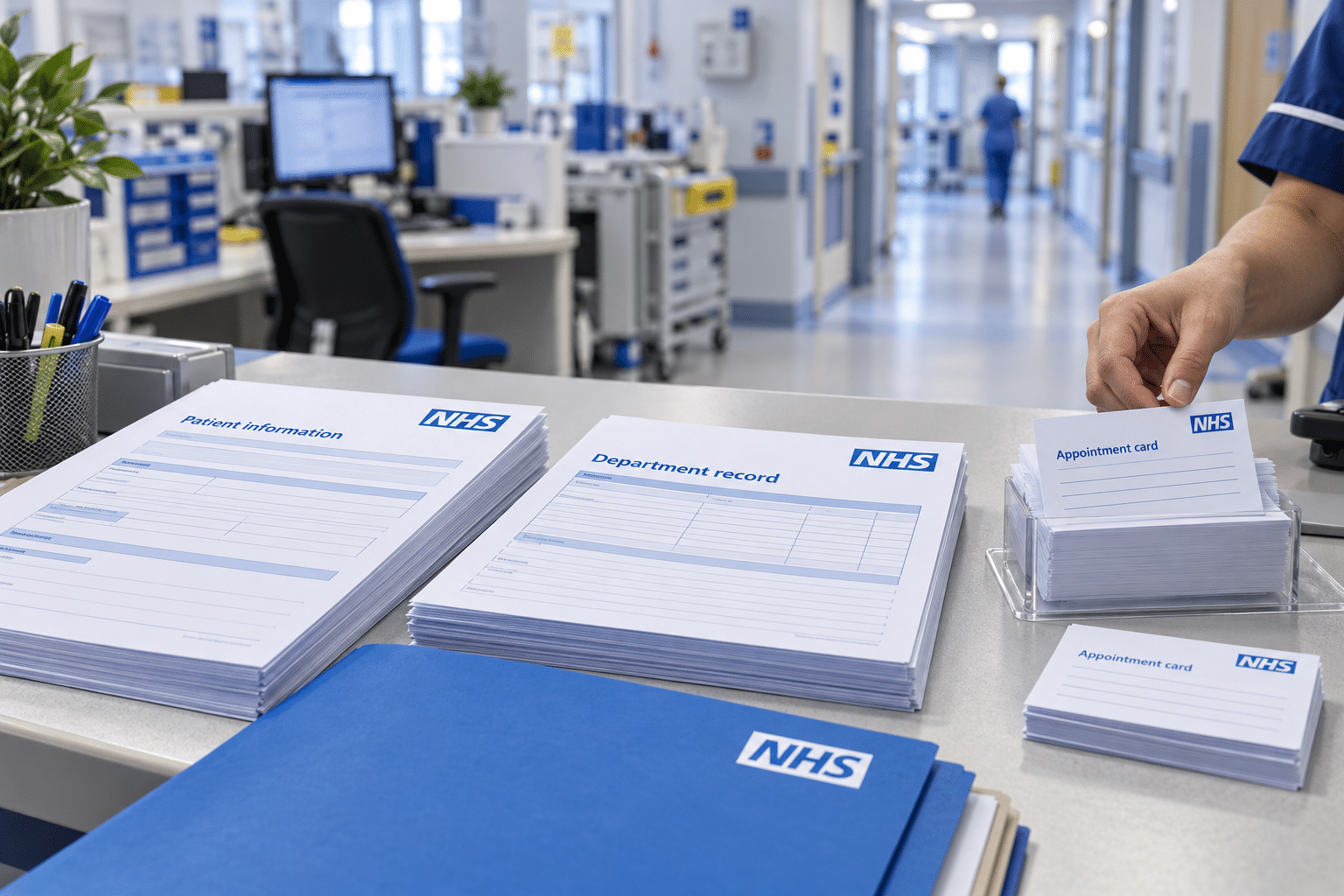
List each item separately: a registration form, appointment card, patient booklet, awareness poster or directional sign. Explain where it will be used and whether staff or patients need to write on it. A stock chosen for an information leaflet may not be the right surface for handwritten forms.
2. State finished size and quantity
Finished size is the final trimmed or folded size. For folded literature, also state the flat size and folding style. For booklets, specify the number of printed pages and whether that total includes the cover.
Give a quantity for each artwork version. “5,000 leaflets” could mean one version of 5,000 or five versions of 1,000, which are different production instructions. Include departmental splits and any packing quantities needed.
3. Describe stock and printing
- Stock: the paper, board or other material being printed.
- GSM: paper mass in grams per square metre, not a direct thickness measurement.
- Simplex or duplex: printing on one side or both sides.
- Colour specification: say whether the work is black-only or full colour, and supply any approved brand requirements.
For an exact repeat order, include the previous specification or a blank sample. Avoid substituting a material without checking its suitability for the task.
4. Confirm finishing requirements
Finishing covers operations after printing, such as trimming, folding and binding. A form may need padding; a booklet may need saddle stitching. If you require perforation, drilling, numbering or collated sets, describe the requirement so availability and pricing can be confirmed.
For signage, include dimensions, intended location, substrate requirements and fitting details. Separate the supply of printed graphics from any installation requirement in the brief.
5. Control artwork versions and proofs
Give each file a clear document reference, revision and approval status. Identify who will approve the proof. Preflight means checking a file for technical print issues; it does not confirm that clinical wording, translations or organisational approvals are correct.
Use blank forms when requesting a print quotation. Patient records are not needed to describe a stationery job. Confirm all wording and the correct artwork version through your team’s approval process before production.
6. Include delivery and purchasing details
State the delivery address, required arrival date, contact person, packing instructions and any purchase order or invoice references. Distinguish an event date from the date the print must arrive so there is time for distribution.
Visit our NHS printing and healthcare signage page or send your specification to info@starprint.org.uk. Star Print can review the brief and confirm the scope, price and production schedule.